SOLID BOWL CENTRIFUGE
MACHINE DESIGN
The feed material is fed into the solid bowl centrifuge with the aid of a pump. Progressive cavity pumps are commonly used for this job, as they ensure a controlled uniform delivery of the feed. The feed rate may be ascertained with the aid of a flow-meter in order to determine the throughput rate per hour or per day.
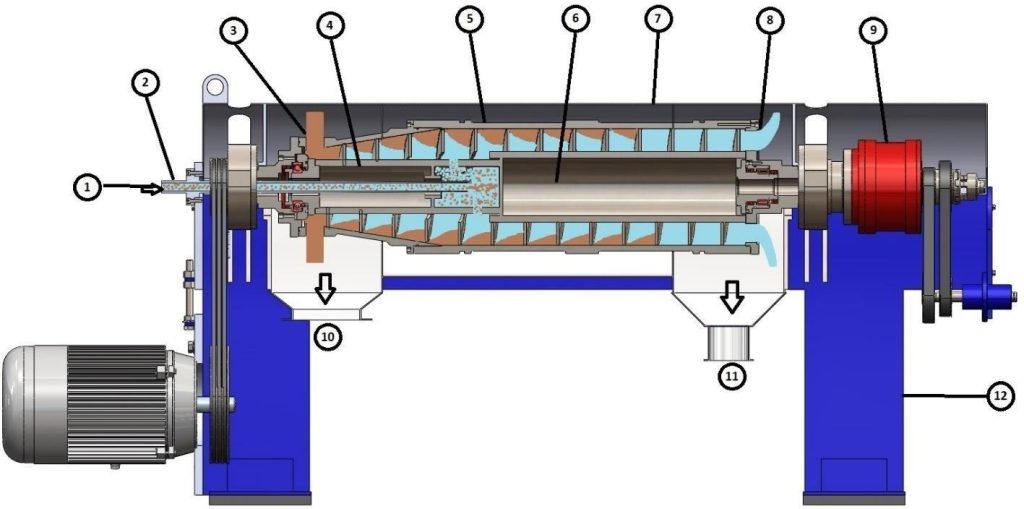
The feed material is first pumped through a stationary feed pipe (1) into the feed compartment (2) which is located in the hub of the internal screw conveyor (5) and within the field of centrifugal forces. The effect of these centrifugal forces causes the feed to flow through the feed compartment outlets (3) and into the bowl (4) of the solid bowl centrifuge..
SEPARATING PROCESS
The principal of co-current flow starts the settling process as the feed enters at the large diameter end of the bowl. Solids and liquids are transported in the same direction. Hence, the complete bowl length is available for settling. This arrangement provides long settling distances and extended sedimentation time for the feed material to be dewatered or thickened. The settling operation proceeds uniformly, trouble free and with minimal turbulence.
The centrifugal force developed during normal operation causes the relatively heavy solid particles to settle on the bowl wall. These sedimented particles are transported inside the bowl by the screw conveyor (5) to the solids discharge point (7) The bowl and screw conveyor rotate in the same direction, but the screw conveyor speed differs slightly from that of the bowl. That differential speed is brought about by a suitable gearbox (6) by the corresponding transmission ratio of the V-Belt drive, or through the utilization of a separate scroll drive system.
PRODUCT DISCHARGE
The separated solids are discharged through the outlet opening (7) and are collected in the casing (8). They are then routed through a chute to be discharged. The centrate flows through the return channels (11) fixed to the conveyor hub in the opposite direction to that of the solids.
The liquid leaves the centrifuge at the feed inlet end. This arrangement avoids interference with the sedimentation process, which normally occurs with the traditional counter-current design.
The return channels for the centrate discharge are sized so that the velocity of the flow substantially prevents the sedimentation of superfine solids contained in the centrate against the interior walls of the channels. The centrate is discharged over vertically adjustable weir plates (12) thus allowing for changes to be made to the centrate level and consequently, altering the volume of liquid retained inside the centrifuge. The centrate is discharged through a chute. Visual inspection of the centrate for the purpose of controlling the centrate clarity is possible by taking samples at the machine outlet. Alternatively, provision can be made for automatic centrate turbidity measurement and adjustment.
CASING
The casing (8) used to contain and direct the separated products also serves as a safeguard against contact with rotating machine components.
BASE FRAME
The base frame (9) of the centrifuge is a vibration insulated support. It is mounted on special vibration isolators which prevent the transmission of harmful vibrations to the support structure, even when starting and stopping the centrifuge.
ADVANTAGES OF CENTRIFUGE –
HUMBOLDT DESIGN FOR SOLID/LIQUID SEPARATION
ECONOMIC SOLID/LIQUID SEPARATION
The separation of solids from liquids and/or dewatering and clarifying respectively are of outstanding importance for any industrial production process and for treating municipal sewage and industrial waste.
Owing to our long-standing activities in the company’s industrial plant business, we have gained extensive experience in these fields. We continually build on our expertise through close contacts with customers and plant operators.
To cover such a wide field of activities, the range of products is not restricted to only thickeners and filters but also includes numerous types of centrifuges for mechanical solids/liquid separation. Every model is offered in several sizes to match the requirements of the application. This background enables the expertise required to offer unbiased advice. When a customer specifies what separating problems they are facing, experts work out the most appropriate solution, either on the customer’s behalf or jointly with the customer.
Apart from a range of individual machines suitable for specific applications, we also offer complete dewatering installations for waste-water and potable water treatment.
RELIABILITY BASED ON EXPERTISE
Our Solid-bowl centrifuges are the outcome of 35 years of development activities. More than 2,000 of these centrifuges are being used to treat over 100 substances of varying separability across the world, in the chemical, pharmaceutical, and food industry, in mineral processing plants and other segments of industry, as well as in municipal facilities. The range of separators is continuously expanding, by the addition of new fields of application and changes in the requirements of our customers. A series of machines ranging from pilot plant sizes up to the largest equipment of this type available anywhere can be provided to meet any requirement of the market.
Our continuous solid-bowl centrifuge with built-in screw conveyor can be almost universally applied whenever solids have to be efficiently separated from liquids of lower specific gravity.
The particle size of the solids may range from several millimeters down to a few microns and the solids structure may be either grainy, crystalline, fibrous or amorphous. The objective of the separation may be either to remove substantial moisture volumes from the solids, its classification by the principle of equal-falling velocity, dynamic thickening of sludges or almost complete clarification of the liquid. Depending on the machine layout and setting, solid-bowl centrifuges can handle both dilute suspensions of low solid content as well as thick slurries and sludges of high solid content.
Three different centrifuge types have been developed to meet the requirements of various conditions of service.
HIGH SEPARATING EFFICIENCY
Subject to the machine having been adjusted to maximum de-watering effect, Humboldt solid-bowl centrifuges achieve residual cake moistures which are unsurpassed by other mechanical de-watering equipment for solids of acceptably good dewatering properties.
SUBSTANTIAL CLARIFYING
Solid-bowl centrifuges of co-current design achieve a well-clarified centrate even from suspensions that contain solids of poor settling properties because this machine design provides both maximum setting distances and quiescent, unhindered sedimentation.
LITTLE FLOCCULANT REQUIRED
Our Solid-bowl centrifuges yield high recovery efficiency even from suspensions containing small amounts of extremely fine solids with minimal usage of polymer flocculants.
A large number of our solid-bowl centrifuges successfully dewater sludges produced in the potash industry, coal flotation tailings, industrial wastewater sludges, and municipal sludges.
WIDE RANGE OF ADJUSTMENT
Centrifuge types can be appropriately set for treating suspensions of low and high solid concentration with particle sizes ranging between 12 mm and a few microns.
COMPACT
Our Solid-bowl centrifuge requires a fraction of the space needed by other mechanical dewatering equipment of identical capacity.
Hence, the portion of construction cost accruing for the pertinent buildings are low and the machines may sometimes even be set up outdoors.
EFFICIENT WEAR PROTECTION
Our Centrifuges provide long service life and experience minimal wear when run under normal operating conditions. The wear resistance is secured by the following alternative measures which are made use after careful analysis of the expected service conditions:
Screw Flight Armouring
- Hard-surfacing with tungsten-carbide, stellite or other suitable alloy
- Sintered tungsten-carbide tiles
- Ceramic tiles
Feed Compartment and Ports
- Hard-surfacing with tungsten-carbide, stellite or other suitable alloy
Solid Discharge Outlet
- Hard-surfacing with tungsten-carbide, stellite or other suitable alloy
LIMITED SPACE REQUIREMENT
Solid-bowl centrifuge requires less space needed by other mechanical dewatering equipment of identical capacity. Hence, the portion of construction cost accruing for the pertinent buildings are low. The machines may sometimes even be set up outdoors.
SPECIAL FEATURES
LOW POWER CONSUMPTION
Our Centrifuges are operated at low “G” force / low speed without turbulence and small breach angle. Hence, the power requirement is low (about 0.8 KWH/M3), resulting inlow wear and tear without compromising dewatering efficiency.
OPTIMUM CAKE DRYNESS
Cake dryness is optimized by varying the differential speed between 3–40 rpm, by simply changing the pulleys and VFD.
EFFICIENT WEAR PROTECTION
Our Centrifuges provide long service life and experience minimal wear under normal operating conditions. Conveyor flight and other wear-prone parts are lined with tungsten carbide, which is far superior to standard stellite hard surfacing.
EASY TO OPERATE
Our Solid bowl centrifuge construction is simple with a Centralised Lubrication System, by which all bearings can be lubricated while the machine is in operation.
COMPACT
Due to its compact design and high specific throughput, the centrifuge requires much less space than most alternative systems. As the centrifuge is a self-contained system, room for peripheral equipment is not necessary.
LOW COST OF OPERATION
The operating cost of the centrifuge is low in terms of power consumption, de-watering polymer requirement, and overall machine life.
SIMPLE INSTALLATION
The centrifuge is simple and easy to install, requiring very little time due to its compact design and the integration of all necessary functions in a single package. There is no requirement for an expensive or complicated foundation.
SEPARATE DRIVE FOR THE SCROLL s BOWL
The scroll drive is provided with a separate drive mechanism by means of VFD to control its rotation in the same direction as the bowl but at a different speed. The centrifuge has both front drive and back drive mechanisms (Dual Drive, controlled by VFD). The drive is linked to the main bowl drive by a Cyclo Gear- box. The differential speed of the scroll is automatically and manually adjustable so the moisture content of the dewatered sludge can be controlled as required.
TYPES OF SLUDGE / MATERIALS HANDLED
- List of Materials
- Acetylene Sludge
- Aluminium Hydroxide
- Biological Sludge
- Blast Furnace Dust
- Chemical Sludge
- Coal Tailings
- De-inking Sludge
- Debarking Sludge
- Decarbonisation Sludge
- Digested Sludge
- Fish Presswater
- Foundry Wastewater
- Galvanic Sludge
- Hydroxide Sludge
- Lamella Sludge
- Lime Sludge
- Oily Sludge
- Paint Sludge
- Palm Oil Sludge
- Papermill Sludge
- Pig Manure
- Potato Washings
- Raw Sludge
- Refinery Sludge
- Slaughterhouse Sludge
- Slop Oil
- Sugar Beet Washings
- Tannery Sludge
- Tunneling Sludge
- Waste Activated Sludge
- Waste Oil
- Water Treatment Sludge
- Wet Scrubber Sludge